

Kuw
ait

ISO 45001 Certification & Consulting Service in Kuwait
QUALIT
CERT
Qualitcert offers ISO 45001 certification and consulting services in Kuwait, supporting organizations in developing and implementing effective Occupational Health and Safety Management Systems (OHSMS) that align with international standards. With a strong emphasis on enhancing workplace safety, minimizing risks, and preventing work-related injuries and illnesses, Qualitcert’s experienced consultants work closely with businesses across diverse sectors to tailor solutions that meet specific operational needs and local regulatory requirements. From initial gap analysis and risk identification to the development of safety policies, training programs, and incident response plans, Qualitcert provides end-to-end guidance throughout the certification journey. Their structured approach ensures that organizations not only meet ISO 45001 standards but also foster a proactive safety culture that promotes employee well-being, boosts productivity, and builds stakeholder confidence. By achieving ISO 45001 certification with Qualitcert’s expert support, companies in Kuwait can demonstrate a firm commitment to occupational health and safety excellence, ensuring compliance while protecting their most valuable asset—their people.
ISO Certification Process – Step by Step Guide
The ISO certification process helps organizations implement international standards to improve quality, safety, efficiency, and compliance. Below is a structured step-by-step ISO certification process followed by professional ISO consultants and certification bodies.
ISO Application
The organization submits an application for ISO certification and defines the scope of certification including departments, processes, and operations.
Gap Analysis
ISO consultants analyze the current management system and identify gaps between existing processes and ISO standard requirements.
ISO Documentation
Preparation of ISO manuals, procedures, policies, risk assessments, and records required to comply with ISO standards.
System Implementation
ISO processes are implemented across departments with employee training, process control, and compliance monitoring.
Internal Audit
Internal auditors review the management system to verify compliance and identify corrective actions before the certification audit.
Management Review
Top management evaluates the effectiveness of the ISO management system and ensures readiness for certification.
Certification Audit
An accredited certification body conducts an external audit to verify compliance with ISO standards.
ISO Certification
After successful audit completion, the organization receives the official ISO certificate demonstrating compliance with international standards.
Surveillance Audits
Annual surveillance audits ensure continuous compliance and improvement of the ISO management system.
Please Reach Us Today


Approach and Methodology used to implement Management System Standard
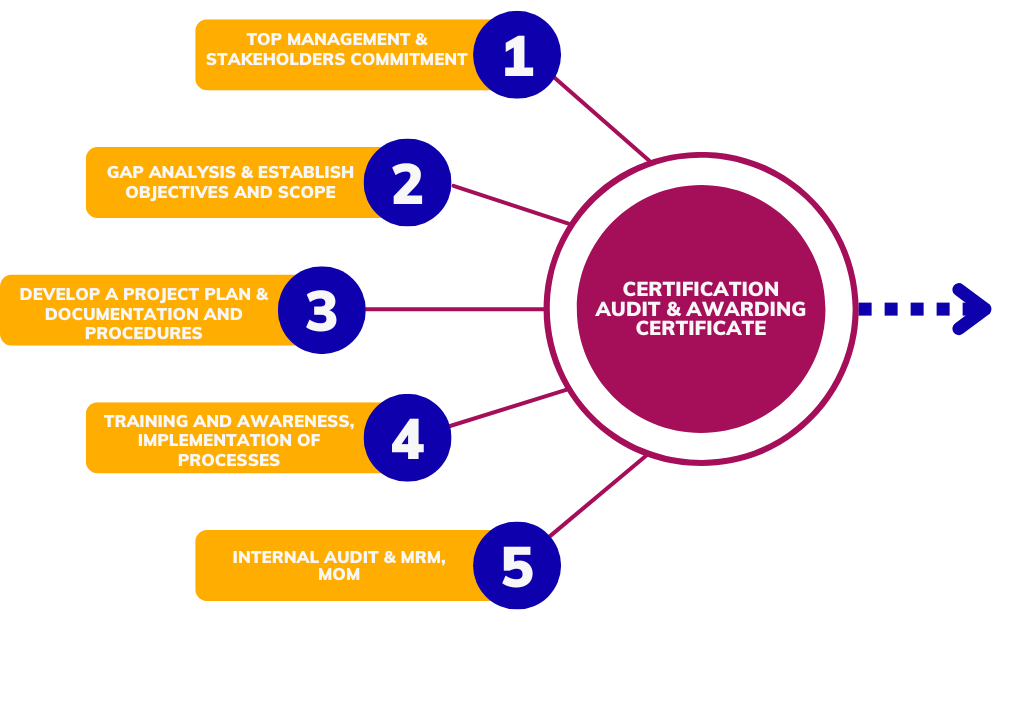
Implementing an ISO standards involves a structured methodology to ensure that the organization effectively meets the requirements of the chosen standard and achieves certification. Sometimes defined methodology may vary depending on factors such as the size of the organization, its industry, and the complexity of the ISO standard being implemented, the following steps provide a basic framework


Benefits of having ISO Certification
Enhanced Credibility and Reputation
Legal and Regulatory Compliance
Enhanced Customer Satisfaction
Access to Global Markets
Environmental Sustainability
Information Security
Our Achievements and Success
Our Clients





OUR
SERVICES
ISO 45001: Build a Practical Occupational Health And Safety Management System for Kuwait
For organisations across Kuwait, ISO 45001 provides a structured way to identify hazards, reduce workplace risks and improve worker consultation and participation, with controls adapted to oil and gas support operations, offices, project sites, warehouses, hospitals, food businesses and technology environments.
ISO 45001 Implementation Aligned with the Operating Environment in Kuwait
The operating environment in Kuwait combines oil, gas and energy support, construction and engineering, logistics and warehousing, healthcare and medical services. This creates different priorities for each organisation, but ISO 45001 provides a common structure for teams that need to identify hazards, reduce workplace risks and improve worker consultation and participation.
Organisations commonly coordinate head offices with industrial areas, project sites, warehouses, healthcare facilities and customer-service locations. The system should define who performs each control, what evidence is retained and how performance is evaluated when conditions or business requirements change.
Qualitcert supports organisations in Kuwait by adapting the implementation work to workplaces, workers, contractors, equipment, tasks, projects and emergency scenarios. The service focuses on practical preparation, documented controls, internal review and readiness for the relevant independent assessment.
Implementation Priorities for ISO 45001 in Kuwait
The system should reflect oil and industrial support, project and contractor operations, warehouse and logistics activity and multi-location service delivery.
Hazard Identification
Evaluate routine, non-routine, emergency and change-related hazards before exposure occurs. In Kuwait, this is especially relevant where organisations manage oil and industrial support.
Hierarchy of Controls
Prioritise elimination, substitution and engineering controls before relying only on procedures or personal protective equipment. In Kuwait, this is especially relevant where organisations manage project and contractor operations.
Worker Participation
Create practical channels for consultation, reporting, investigation and involvement in safety decisions. In Kuwait, this is especially relevant where organisations manage warehouse and logistics activity.
Contractor Governance
Define prequalification, induction, supervision, permit, monitoring and incident responsibilities for outsourced work. In Kuwait, this is especially relevant where organisations manage multi-location service delivery.
ISO 45001 Applications Across Key Sectors in Kuwait
The exact controls should be adapted to the sector, operating model, customer commitments and risks present in Kuwait.
Oil, Gas and Energy Support
Apply hazards, worker participation, contractor controls, emergency readiness and incident learning across high-risk assets, contractors, maintenance, utilities and operationally critical services, with evidence matched to the services and operating risks present in Kuwait.
Construction and Engineering
Control hazards, worker participation, contractor controls, emergency readiness and incident learning across project planning, contractors, materials, inspections, changing site conditions and handover, with evidence matched to the services and operating risks present in Kuwait.
Logistics and Warehousing
Document hazards, worker participation, contractor controls, emergency readiness and incident learning across shipments, warehouses, fleets, partner interfaces and time-sensitive service handovers, with evidence matched to the services and operating risks present in Kuwait.
Healthcare and Medical Services
Verify hazards, worker participation, contractor controls, emergency readiness and incident learning across sensitive records, specialist equipment, competence, suppliers and continuity-sensitive services, with evidence matched to the services and operating risks present in Kuwait.
Food and Hospitality
Strengthen hazards, worker participation, contractor controls, emergency readiness and incident learning across suppliers, processing, storage, handling, distribution and customer-facing food operations, with evidence matched to the services and operating risks present in Kuwait.
Technology and Professional Services
Coordinate hazards, worker participation, contractor controls, emergency readiness and incident learning across cloud platforms, software changes, digital services, data flows, vendors and remote access, with evidence matched to the services and operating risks present in Kuwait.
A Structured Route to ISO 45001 Certification Readiness
The implementation should prioritise significant risks and demonstrate participation, control and continual improvement.
Define Context and Scope
Identify workplaces, activities, workers, contractors, interested parties and organisational boundaries.
Identify Hazards and Assess Risks
Evaluate tasks, equipment, environments, people and changes using a defined risk method.
Determine Legal and Other Requirements
Organise applicable duties, permits, customer requirements and internal commitments.
Plan Controls and Objectives
Apply the hierarchy of controls and establish measurable improvement plans with responsible owners.
Implement Operational Controls
Use procedures, permits, inspections, competence, procurement and contractor controls.
Prepare and Test Emergency Response
Define scenarios, resources, communication, drills and lessons learned.
Audit and Review the System
Complete internal audit, incident review, performance evaluation and management review.
Prepare for Certification Audit
Confirm implementation evidence, worker awareness and corrective-action closure.
ISO 45001 Documents, Safety Records and Project Factors
The records must demonstrate that hazards are controlled, workers are involved and safety performance is reviewed.
Typical OHSMS Documents and Records
- OHS management system scope
- Health and safety policy and objectives
- Hazard and risk register
- Legal and other requirements register
- Operational-control procedures
- Permit-to-work and inspection records
- Training and competence records
- Worker consultation and participation records
- Contractor evaluation and monitoring
- Incident and near-miss investigations
- Emergency drill records
- Internal-audit, management-review and corrective-action records
Scope, Effort and Timeline Factors
The implementation effort should be estimated from the actual activities, locations, risks and current controls rather than from a single package used for every organisation.
- Number and type of workplaces in scope
- Workforce size, shifts and contractor involvement
- Risk level of construction, machinery or transport activities
- Existing permits, inspections and incident records
- Need for task-specific risk assessments
- Legal and customer safety requirements
- Availability of competence and consultation evidence
- Readiness for internal audit and external certification
Why Choose Qualitcert for ISO 45001 Support in Kuwait?
Qualitcert helps organisations build an occupational health and safety system that connects risk assessment, operational controls and worker participation.
The support prepares the organisation for audit while preserving the independent role of the certification body in assessing conformity and issuing certification.
Risk Workshops
Evaluate hazards and controls with participation from relevant operational teams.
Legal Register Support
Organise applicable requirements, responsibilities and evaluation evidence.
Contractor Controls
Develop practical prequalification, induction, supervision and monitoring arrangements.
Incident Improvement
Strengthen investigation, root-cause analysis and corrective-action verification.
Internal Audit
Review implementation at workplaces, projects and contractor-controlled activities.
Management Oversight
Build meaningful objectives, indicators and review routines for leadership.
ISO 45001 Support Across Kuwait
Support can be adapted for organisations operating across Kuwait's commercial centres, oil and industrial areas, project sites, warehouses, healthcare facilities and hospitality locations.
Where several locations are included, central governance should be linked to clear site responsibilities, operational controls and locally maintained records.
ISO 45001 Questions from Organisations in Kuwait
These answers provide general guidance for Kuwait; the final scope depends on the organisation's activities, locations, risks and current evidence.
What is ISO 45001?
ISO 45001 specifies requirements for an occupational health and safety management system designed to prevent work-related injury and ill health and improve safety performance.
Which organisations in Kuwait can use ISO 45001?
The standard can be used by organisations of any size, including construction, logistics, manufacturing, hospitality, healthcare and office-based businesses.
Does ISO 45001 require worker consultation?
Yes. The standard requires consultation and participation of workers, including non-managerial workers, in relevant safety-management activities.
What is the hierarchy of controls?
It is an order of preference for risk reduction, beginning with elimination and followed by substitution, engineering controls, administrative controls and personal protective equipment.
Can ISO 45001 cover multiple operating locations in Kuwait?
Yes. A common OHSMS may cover several workplaces when local hazards, worker participation and operational controls are evaluated at each site.
Are contractors included in ISO 45001?
The organisation must control relevant outsourced functions, contractor activities and procurement processes within the scope of its management system.
Can ISO 45001 be integrated with ISO 9001 and ISO 14001?
Yes. Common processes such as objectives, document control, internal audit, management review and corrective action can be integrated.
What evidence is checked during an audit?
Auditors may review risk assessments, permits, inspections, training, consultation, contractor controls, incidents, emergency drills, internal audits and management reviews.
Who issues the ISO 45001 certificate?
An independent certification body conducts the certification audit and makes the certification decision.
Are surveillance audits required after certification?
Yes. The organisation must maintain its safety management system and undergo periodic surveillance assessments.
Plan Your ISO 45001 Readiness Review in Kuwait
Share the activities, locations, systems, products or services you want included. Qualitcert can help define a practical scope for oil and gas support operations, offices, project sites, warehouses, hospitals, food businesses and technology environments.