

Bang
alore

ISO 27001 Certification & Consulting Service in Bangalore
QUALIT
CERT
Qualitcert, a prominent ISO 27001 certification and consulting service provider in Bangalore, India. Specializing in information security management systems (ISMS), Qualitcert assists organizations in implementing robust frameworks aligned with ISO 27001 standards. Their approach involves thorough risk assessment, security controls implementation, and continuous monitoring to safeguard sensitive information and ensure compliance. With expert guidance from Qualitcert consultants, businesses receive support in documentation, training, and system integration to establish and maintain effective ISMS. Qualitcert also facilitates preparation for certification audits, enabling organizations to achieve ISO 27001 accreditation and demonstrate their commitment to protecting data and mitigating security risks. Through their services, Qualitcert empowers businesses in Bangalore to enhance their cybersecurity posture, build trust with stakeholders, and stay resilient in the face of evolving threats.
ISO Certification Process – Step by Step Guide
The ISO certification process helps organizations implement international standards to improve quality, safety, efficiency, and compliance. Below is a structured step-by-step ISO certification process followed by professional ISO consultants and certification bodies.
ISO Application
The organization submits an application for ISO certification and defines the scope of certification including departments, processes, and operations.
Gap Analysis
ISO consultants analyze the current management system and identify gaps between existing processes and ISO standard requirements.
ISO Documentation
Preparation of ISO manuals, procedures, policies, risk assessments, and records required to comply with ISO standards.
System Implementation
ISO processes are implemented across departments with employee training, process control, and compliance monitoring.
Internal Audit
Internal auditors review the management system to verify compliance and identify corrective actions before the certification audit.
Management Review
Top management evaluates the effectiveness of the ISO management system and ensures readiness for certification.
Certification Audit
An accredited certification body conducts an external audit to verify compliance with ISO standards.
ISO Certification
After successful audit completion, the organization receives the official ISO certificate demonstrating compliance with international standards.
Surveillance Audits
Annual surveillance audits ensure continuous compliance and improvement of the ISO management system.
Get In Touch


Approach and Methodology used to implement Management System Standard
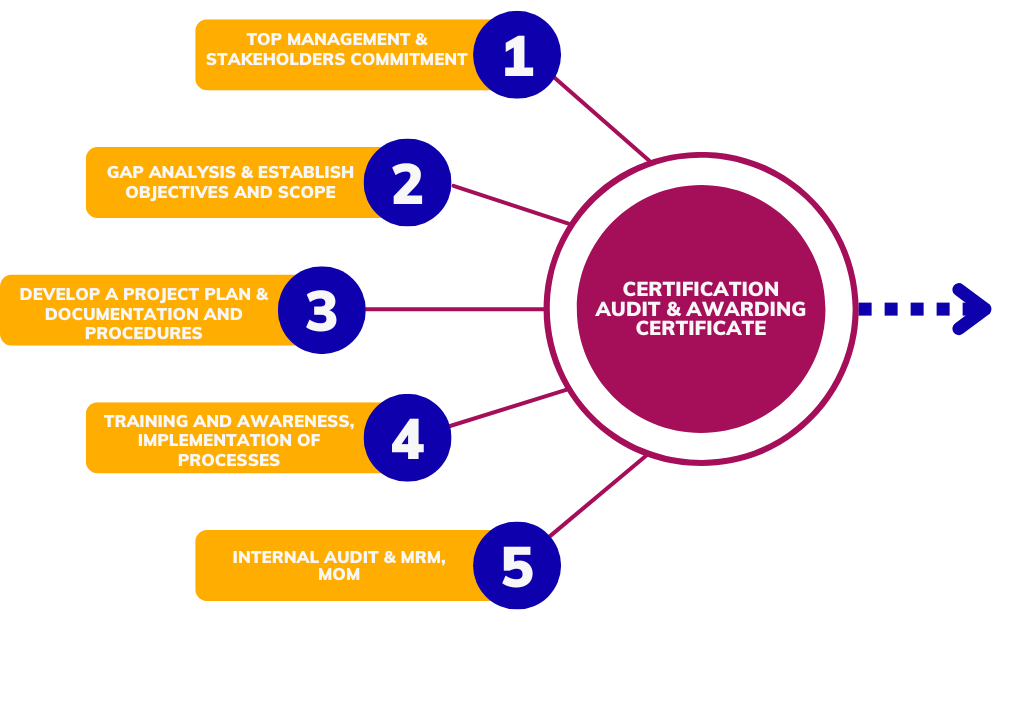
Implementing an ISO standards involves a structured methodology to ensure that the organization effectively meets the requirements of the chosen standard and achieves certification. Sometimes defined methodology may vary depending on factors such as the size of the organization, its industry, and the complexity of the ISO standard being implemented, the following steps provide a basic framework

OUR
Process
1, Determine the ISO Standard
2. Understand the Requirements
3. Training and Awareness
4. Implement the System
5. Internal Audit
6. Certification

Benefits of having ISO Certification
Enhanced Credibility and Reputation
Legal and Regulatory Compliance
Enhanced Customer Satisfaction
Access to Global Markets
Environmental Sustainability
Information Security
Our Achievements and Success
Our Clients





OUR
SERVICES
ISO 27001 Consulting in Bangalore for Risk-Based Information Security
Build an ISMS that connects business risk, customer assurance, regulatory obligations, the Statement of Applicability and Annex A controls across technology-driven operations.
Make security governance as scalable as your technology
Bangalore organisations develop software, operate platforms, process client data and manage global delivery relationships in environments where threats and customer expectations change quickly. ISO/IEC 27001 provides the governance structure needed to manage that risk systematically.
Our work begins with ISMS context, scope, interested parties, information assets and risk criteria. Risk assessment is tied to business impact rather than reduced to a generic checklist.
Risk treatment decisions are documented through the Statement of Applicability, with Annex A controls selected, justified and assigned to accountable owners. Policies, procedures and technical evidence are aligned to the actual environment.
Internal audit, incident learning, metrics and management review create a cycle for maintaining security as systems, suppliers, teams and services evolve.
ISMS priorities for Bangalore's software, cloud and service ecosystem
A credible ISMS helps organisations demonstrate disciplined control over data, infrastructure, people, suppliers and secure delivery.
SaaS providers, engineering centres, BPO operations, fintech firms and start-ups often need to answer detailed customer security assessments before contracts can progress. ISO 27001 provides an independently auditable foundation for those discussions.
The standard also helps teams govern remote access, cloud services, development environments, privileged accounts, third parties, incident response, continuity and secure change.
Qualitcert helps security, technology, legal, HR and business leaders create one integrated risk treatment programme rather than disconnected documents.
How ISO 27001 supports trust and resilience
The value lies in making security decisions traceable, risk-based and repeatable across business and technical teams.
Better risk ownership
Business owners can see residual risk, treatment status and the decisions requiring acceptance or investment.
Stronger customer assurance
Controlled evidence supports due diligence, tenders and security reviews from clients and partners.
More coordinated incident response
Roles, escalation, evidence handling and lessons learned are planned before a security event occurs.
Improved supplier governance
Security expectations, assessments and monitoring are aligned with the information and services entrusted to third parties.
ISO 27001 applications in Bangalore' service economy
The scope and controls should reflect information flows, technology dependencies and contractual commitments.
SaaS and Cloud Platforms
Govern tenant data, cloud configurations, access, change, incident response and suppliers.
IT and Engineering Services
Protect client information across projects, development teams and delivery locations.
Fintech and Payments
Control sensitive data, privileged access, secure development and third-party dependencies.
BPO and Shared Services
Demonstrate consistent security for customer processes, workstations and workforce access.
Health Technology
Protect health information, devices, integrations and service availability.
Start-up Product Companies
Build scalable security governance before enterprise due diligence accelerates.
From scope and risk assessment to an auditable ISMS
ISO 27001 implementation works best when risk treatment and operational evidence are developed together.
Define the ISMS boundary
Confirm sites, services, systems, people, interfaces and exclusions that shape the certification scope.
Establish risk methodology
Set criteria for likelihood, impact, acceptance, ownership and consistent information-security risk evaluation.
Assess and treat risks
Identify assets, threats and vulnerabilities, then select avoidance, modification, sharing or acceptance options.
Implement Annex A controls
Prepare the Statement of Applicability and operate selected organisational, people, physical and technological controls.
Measure and challenge
Monitor objectives, incidents, supplier performance, vulnerabilities and control effectiveness through internal audit.
Review and certify
Complete management review, corrective actions and evidence preparation for the certification audit stages.
Policies, registers and records expected during ISO 27001 assessment
Documentation should explain the organisation's security logic and provide evidence that selected controls are operating.
Common ISMS records
- ISMS scope and policy
- Risk assessment methodology
- Information risk register
- Risk treatment plan
- Statement of Applicability
- Asset and access records
- Supplier security assessments
- Incident response records
- Internal audit programme
- Management review minutes
ISMS mistakes that weaken assurance
Certification problems often arise when technical controls exist but governance, risk reasoning or operating evidence is incomplete.
- Copying a generic risk register that does not reflect real services and information flows.
- Selecting all Annex A controls without documenting applicability and treatment rationale.
- Restricting the ISMS to IT while business owners and suppliers remain outside the process.
- Listing policies without retaining logs, reviews, approvals or test evidence.
- Accepting residual risk informally without defined authority or review dates.
Related ISO/IEC 27001 Services for Bangalore Organisations
For a connected requirement, review SOC 2 services in Bangalore to coordinate shared governance, documentation and management responsibilities.
For a connected requirement, review VAPT services in Bangalore where common risks, suppliers or operational controls should be aligned.
For a connected requirement, review SOC 1 services in Bangalore to reduce duplicated work and build a coherent assurance programme.
ISO 27001 questions from Bangalore-based organisations
These answers focus on risk assessment, Annex A, scope, evidence and certification.
What is an Information Security Management System?
An ISMS is a coordinated set of policies, risk processes, responsibilities, controls and reviews used to protect information and improve security performance.
Does ISO 27001 require every Annex A control?
No. The organisation considers all Annex A controls, but selects those needed based on risk treatment and other requirements, documenting decisions in the Statement of Applicability.
What is the Statement of Applicability?
It records control applicability, justification, implementation status and references, providing a bridge between risk treatment and the Annex A control set.
Can a cloud-based company be certified to ISO 27001?
Yes. The organisation must define its scope and manage shared responsibilities, suppliers, access, configuration, monitoring, backup and incident obligations.
How detailed should the information risk register be?
It should be detailed enough to support consistent decisions, clear ownership, treatment tracking and residual risk acceptance without becoming unmanageable.
Is penetration testing mandatory for ISO 27001?
The standard does not prescribe one universal test schedule, but vulnerability and security testing may be necessary based on risk, contractual duties and selected controls.
How are suppliers included in an ISMS?
Suppliers are assessed according to the information, systems and services they affect, with security requirements, monitoring and exit arrangements defined as appropriate.
What is the difference between risk assessment and risk treatment?
Assessment identifies and evaluates risk. Treatment decides what to do about it, assigns actions, selects controls and documents residual risk.
Can ISO 27001 support client security questionnaires?
Yes. A controlled ISMS provides policies, risk records, audits, incident processes and control evidence that can make due diligence more consistent.
How does Qualitcert support ISO 27001 in Bangalore?
Qualitcert can help define scope, create the risk framework, prepare the Statement of Applicability, document controls, audit the ISMS and prepare for certification.
Define Your Bangalore ISO 27001 Implementation Roadmap
Clarify scope, complete a risk-led gap review and organise the Statement of Applicability, Annex A evidence and audit programme.